Insight to Action
At Identity Impact Consultancy, we have designed an Insight to Action Engagement Framework that guides leaders and boards to design meaningful, culturally appropriate engagement, make sense of what is heard, and translate this into structured, evidence-informed action.
The Insight to Action Framework is grounded in established research across organisational theory, qualitative inquiry, and change practice. It brings together complementary bodies of work, including sensemaking, psychological safety, participatory engagement, improvement science, and procedural justice. In addition to this research base, the framework has been applied and refined across a range of organisational contexts through the work of Dr Julia Tod, Identity Impact Consultancy. This application has enabled the framework to be tested in practice, ensuring it is both theoretically sound and practically effective in real-world environments.
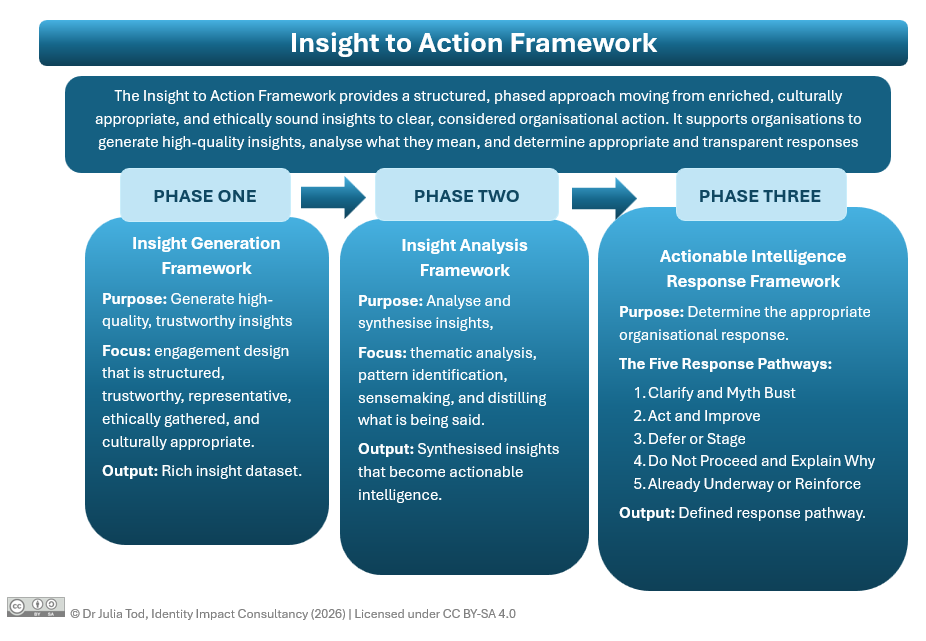
Collectively, this research and practice base demonstrates that high-quality organisational action depends on three critical phases. First, insights are generated through well-designed, ethical, and inclusive engagement. Second, those insights are analysed in a structured and disciplined way to identify patterns, meaning, and what matters most. Third, organisations determine their response through clear, principled, and transparent decision making
By integrating these foundations, the Insight to Action Framework provides a coherent, research-informed and practice-tested methodology for moving from enriched, culturally appropriate, and ethically sound insights to clear, considered, and transparent organisational action.
Insight to Action Framework
The Insight to Action Framework provides a structured, phased approach moving from enriched, culturally appropriate, and ethically sound insights to clear, considered organisational action. It supports organisations to generate high-quality insights, analyse what they mean, and determine appropriate and transparent responses.
Organisations, with good intentions, want to engage with their people and key stakeholders to gather insights. Yet when this is not carefully designed, it can fall short of its purpose and, unfortunately, even create unintended harm. There needs to be intentional planning and investment.
Phase One: Insight Generation
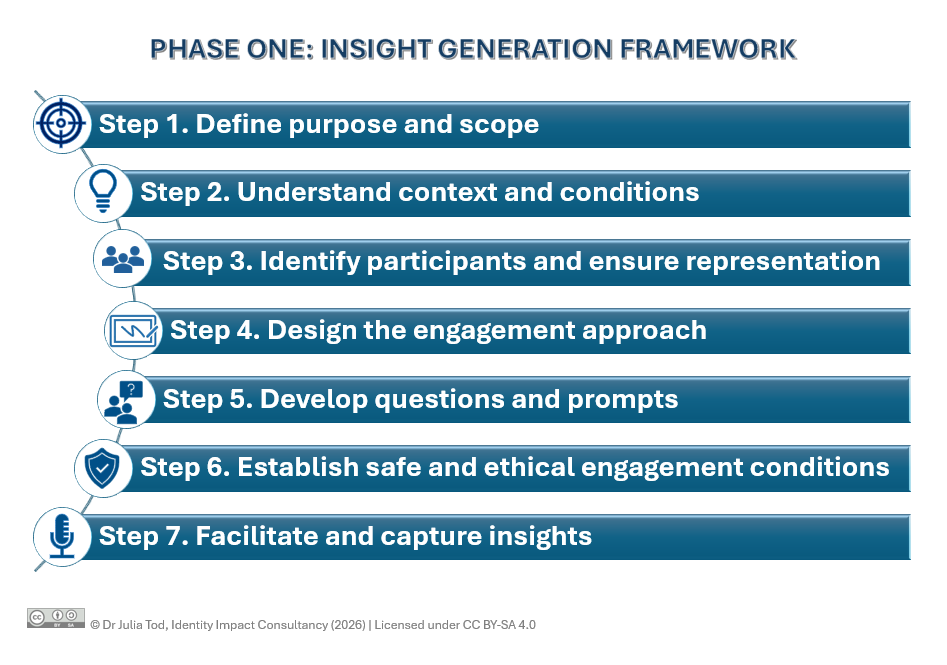
Meaningful insight generation is not simply about asking questions. It is about creating the conditions where people feel safe, respected, and genuinely invited to contribute. At its core, this phase is grounded in whakawhanaungatanga and manaakitanga and how we engage with people, not just what we ask of them. When this phase is carefully designed and resourced, it mitigates the risk of surface-level responses, disengagement, or misinterpretation of what people are really saying. It strengthens the quality of insights and the integrity of what follows. In an Aotearoa context, this also means upholding Te Tiriti o Waitangi and ensuring that engagement approaches are culturally grounded, respectful, and responsive.
Phase Two: Insight Analysis
On the surface, reviewing data, identifying themes, and summarising findings can seem straightforward. In reality, phase two carries significant responsibility and requires a specific skill set. It is also the point at which organisational trust is either strengthened or quietly eroded. This phase requires careful consideration of how insights are held, interpreted, and protected in ways that uphold mana and ensure people feel safe in what they have shared. “Raw” data is not neutral. It can be sensitive, identifiable, and, if handled poorly, can cause harm. This means analysis is not just analytical; it is ethical.
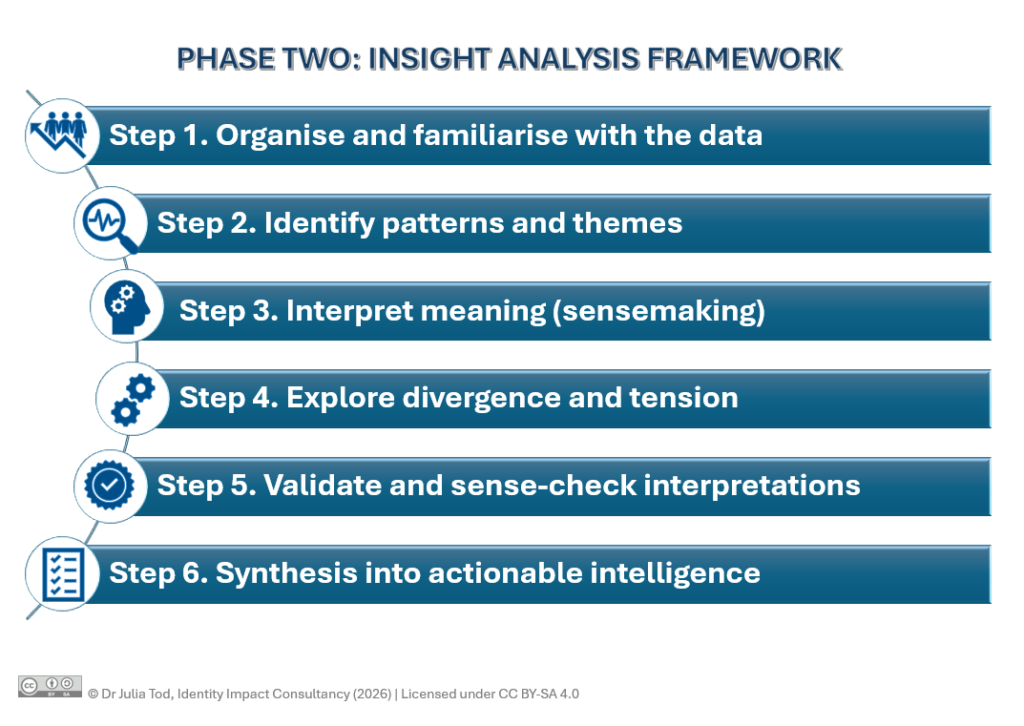
High-quality insight analysis involves:
– Investing in impartial expertise to fully engage with the data, otherwise organisations risk drawing conclusions that are incomplete, misrepresentative, or disconnected from what people were actually trying to express.
– Identifying patterns and interpreting meaning across perspectives, recognising that people communicate in layered and nuanced ways.
– Validating and sense-checking interpretations to ensure the findings accurately and safely represent what was shared.
In an Aotearoa context, where te reo Māori and other languages relevant to your context are present, interpretation must go beyond direct translation. It requires understanding the intent, cultural context, and worldview that sit behind what is being shared. Without this, there is a real risk that meaning is diluted, misunderstood, or misrepresented.
– Synthesising insights into clear, meaningful intelligence that can inform decision making, while ensuring individuals are not identifiable (as appropriate) and that no harm is caused through how insights are presented or used.
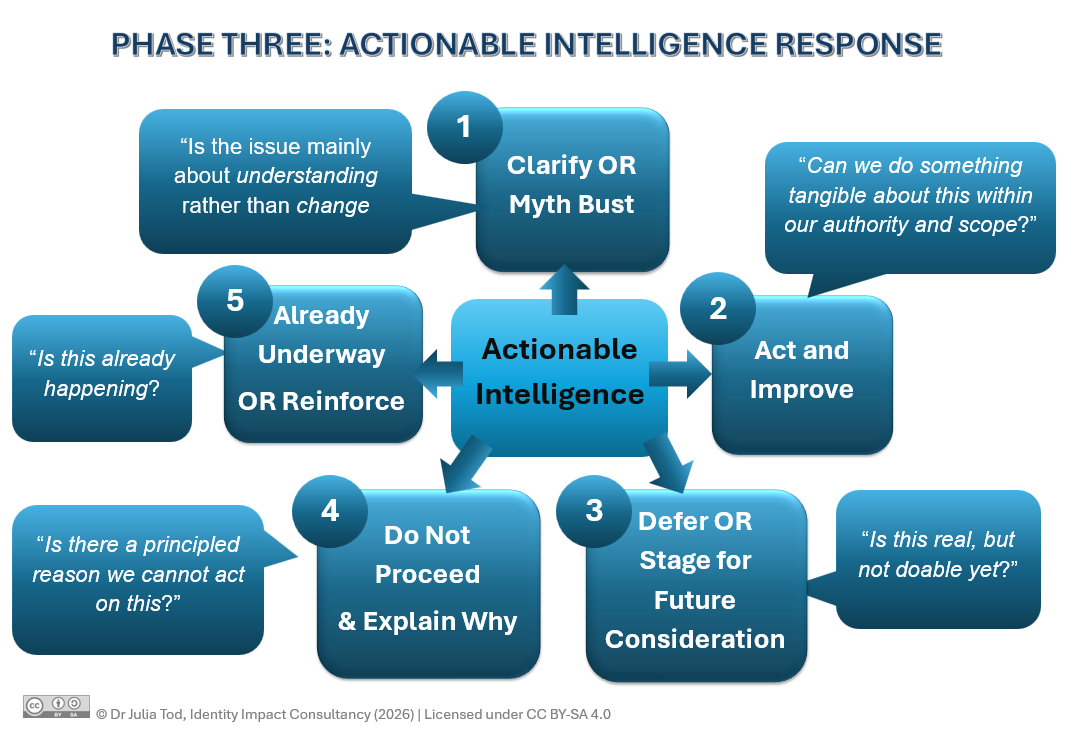
Phase Three: Actionable Intelligence Response
Phase Three brings engagement activies to its most visible point. This is where organisations decide what happens next. This is where organisations either strengthen trust and credibility, or unintentionally undermine it.
People do not only want to be heard.
They want to understand what has been done with what they shared, and why. This is also where procedural fairness becomes critical. Even where decisions are not what individuals or groups may have hoped for, clarity and transparency in how those decisions were reached matters
A strong Actionable Intelligence Response Framework supports organisations to:
– Clarify what is being acted on, what is not, and the rationale for both.
– Make visible how insights have informed decisions.
– Balance diverse and at times competing perspectives in a way that is fair and considered.
– Ensure responses are proportionate to the level of impact on people, recognising that not all decisions carry the same weight.
– Communicate decisions in ways that are clear, respectful, and maintain trust.
When this phase is done well, people can see themselves reflected in the outcome, even if the outcome is not exactly what they expected. When it is not done well, the risk is not just disappointment. It is disengagement.
Important Note
The Insight to Action Framework, comprising the Insight Generation Framework, Insight Analysis Framework, and Actionable Intelligence Response Framework, is licensed under the Creative Commons Attribution-ShareAlike 4.0 International Licence (CC BY–SA 4.0). You are free to share and adapt this material, provided appropriate credit is given. Any adaptations must be shared under the same licence.
Use of this framework should acknowledge its original intent and integrity. If sharing or referencing this framework, please use the following attribution:
Dr Julia Tod, Identity Impact Consultancy (2026). Insight to Action Framework. Licensed under CC BY–SA 4.0. https://creativecommons.org/licenses/by-sa/4.0/